Silicon Valley’s Highest-Signal Robotics Room: Junfan Zhu’s Saturday Robotics
Dek: Junfan Zhu built the Bay Area's densest physical-AI technical and research community.
SAN FRANCISCO — On a Saturday afternoon in downtown San Francisco, about a hundred people are packed into a room arguing over whether a robot can dream. The crowd is not the usual meetup blend of recruiters and the merely curious. In the front rows sit research leads from Google DeepMind's Gemini Robotics team, engineers from NVIDIA's GEAR Lab, researchers from Meta's FAIR lab, and founders of venture-backed robotics startups. The person running the clock and steering the argument is Junfan Zhu.
Zhu is the founder of Saturday Robotics, a weekly research community that has become, in less than four months, one of the highest-signal gathering points for the field the industry now calls "physical AI" — the effort to build machines that understand and act in the physical world rather than merely generate text. The community counts more than 2,100 subscribers on its event page and over 1,400 members on Discord as of July 2026, and it caps its in-person sessions at roughly 100 vetted attendees, about half of them active researchers and startup executives.
That such a community exists — and that it is run not by a university or a corporate lab but by a single researcher organizing it on his own time — is itself a story about where AI is heading in 2026.
The benchmark moment
For most of the last three years, "AI" has meant large language models: systems that predict the next word. A growing camp of senior researchers argues that machines operating in the physical world need something different — "world models" that learn the dynamics of reality and can predict what happens if an action is taken. The bet has become one of the most heavily funded ideas in AI: Turing Award winner Yann LeCun left Meta to raise more than $1 billion for a world-models startup, and Fei-Fei Li's World Labs raised $1 billion on the same thesis.
Zhu's claim is that the capital alone does not fix the field's real constraint. "Robotics doesn't have a scaling-law problem. Robotics has a data-generation problem," he argues. Where language models learned from an internet that already existed, robots have no equivalent corpus of "state, action, next state" waiting to be scraped. His conviction is that the breakthrough will not be a bigger model but a better yardstick: "In language, the GPT moment came right after the benchmark moment. I don't think robotics has had its benchmark moment yet."
His own work is concentrated exactly there — in building the yardsticks. Zhu is a contributing author of Agents' Last Exam (ALE), a benchmark led by UC Berkeley's Center for Responsible, Decentralized Intelligence, with Berkeley professor Dawn Song among its co-authors, that tests whether AI agents can execute long-running professional workflows across 55 fields. The arXiv paper, posted June 3, 2026, was "developed in collaboration with 250+ industry experts" and reported a sobering baseline: frontier agents passed, on average, just 2.6% of its hardest tier.
Five weeks later, the benchmark had its moment of arrival. When OpenAI released GPT-5.6 on July 9, the opening section of its announcement led with Agents' Last Exam — the first benchmark figure in the release — touting a new high score of 53.6 for its flagship model. For a benchmark barely a month old to become the headline yardstick of a frontier-model launch is about as fast as influence travels in AI. It is also a precise, public validation of the thesis Zhu keeps repeating: the benchmark moment comes first.
His other work follows the same line. He is a co-author of QuantEval, a benchmark for evaluating large language models on quantitative-finance reasoning, released on arXiv in January 2026. And the Interactive Enhanced Driving Dataset, an autonomous-driving dataset he co-authored, has been accepted for publication in Scientific Data, a Nature Portfolio journal.
The field, in turn, has begun asking Zhu to judge it. He has been invited to referee three submissions for NeurIPS 2026, machine learning's most competitive venue. And in mid-July he served as an invited judge at the Embodied Metal Hackathon, an approval-gated robotics competition at San Francisco's Mission Robotics facility, evaluating live demonstrations from roughly 80 teams that trained real robotic arms and humanoids to perform novel physical tasks. In research, publishing gets you in the room; being asked to referee other people's work is what marks you as part of the field's quality control.
Why Saturday Robotics matters
Still, the thing Zhu is best known for is the room itself. "The Bay Area produces a disproportionate share of the world's frontier physical-AI work, but the convening infrastructure for it was missing," he says of why he built Saturday Robotics.
It is not a passive Discord server or a networking mixer. Each week runs as a working session, curated by Zhu: a keynote from an active researcher, then an open-floor roundtable where frontier papers get taken apart. Admission is application-based and vetted. Past keynote speakers have come from NVIDIA's GEAR Lab, Meta FAIR, UC Berkeley, and Stanford. The institutional roster of attendees reads like a map of the field: Boston Dynamics, Google DeepMind, NVIDIA, Stanford, UC Berkeley, CMU, Dyna Robotics, ByteDance, Tesla, Generalist, Rhoda AI, and Physical Intelligence.
The community has drawn recurring public attention from senior figures in the field, including Yann LeCun, who has liked and shared several of Zhu's technical session recaps on X — including a widely engaged writeup of the group's first session, posted in late March 2026.
In June 2026, Zhu brought the format to CVPR — the field's flagship computer-vision conference, which ran June 3–7 at the Colorado Convention Center in Denver — hosting a Saturday Robotics research night in partnership with the spatial-AI company behind the open-source SpatialLM models. The Denver event drew more than 600 registrations and featured talks from Cosmos-3 researchers at NVIDIA, the University of Pennsylvania's GRASP Lab, and robotics startup X Square Robot, among others.
The signal-to-noise ratio is the point. In a Bay Area saturated with AI events, Saturday Robotics has positioned itself as the place where the people actually building robot foundation models talk shop without the hype — and the platforms asking for Zhu keep getting bigger. In the same mid-July stretch, he moderated a panel at AUTONOMOUS, an industry conference on robotics and physical AI, pressing the chief executives of Foundry Robotics, Industrial Next, and Faraday Future's embodied-AI unit on whether physical AI is actually ready for production lines; and he is an organizer of the "World Models for Robotics" Birds of a Feather session at SIGGRAPH 2026 in Los Angeles, the graphics and simulation community's flagship conference. Manning Publications has brought him on as a technical editor for a forthcoming book on robotics and world models.
The critic's read
None of this guarantees Zhu's bets pay off. The world-models thesis, for all its funding momentum, remains unproven at the level of shipped products, and even its best-funded champions describe product horizons in years, not quarters. Zhu is blunt about the same gap: "Demo is 90%, production is 99%, and that last decimal is a decade of work."
And communities built on the energy of one founder are fragile. The real test of Saturday Robotics is whether it outlasts any single venue, sponsor, or moment.
But the broader phenomenon Zhu embodies — an independent, elite research community forming outside the traditional institutions of academia and Big Tech, organized by a researcher whose benchmarks now sit at the front of frontier-model launches — is a genuine signal about how fast physical AI is moving, and about who is doing the organizing. For now, the room he builds every Saturday is where a real slice of that future is being argued out.
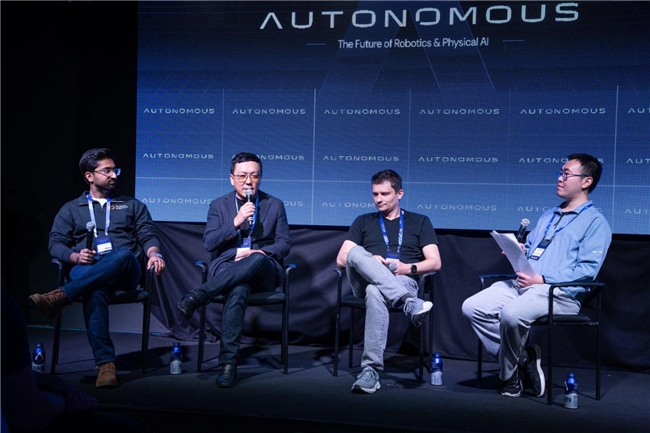
Junfan Zhu moderates the panel "Rebuilding the Factory: Physical AI on the Production Line" at AUTONOMOUS 2026 in San Francisco, leading a discussion with executives from Foundry Robotics, Industrial Next, and Faraday Future on the deployment of embodied AI in industrial production.
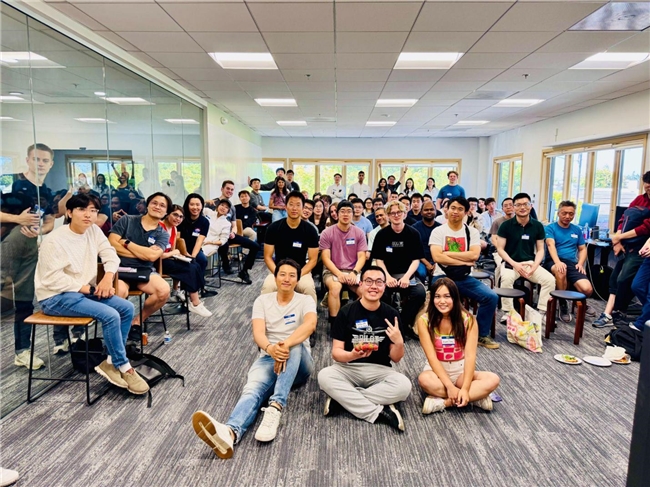
Junfan Zhu hosting Saturday Robotics & World Models Reading Club, June 27, Los Altos, California
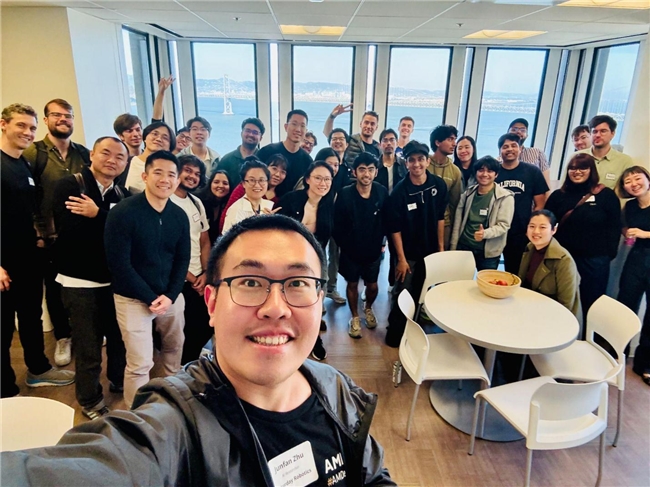
Junfan Zhu hosting Saturday Robotics & World Models Reading Club, May 23, San Francisco, California